Behavioral API Security Without Sending Your Traffic Outside Your VPC
How Proxyble analyzes and enforces API behavior locally, including in fully disconnected environments.

Behavioral API Security Without Sending Your Traffic Outside Your VPC
How Proxyble analyzes and enforces API behavior locally, including in fully disconnected environments.
API-security systems operate close to some of the most sensitive activity inside an application environment. Even when they do not inspect full request bodies, they can still observe information that reveals how services are used and how clients behave.
That information may include API routes, client identities, authentication context, request frequency, error patterns, response characteristics, connection behavior, and service usage over time. Taken together, these signals can reveal meaningful details about application architecture, internal services, operational patterns, and users.
For many organizations, sending this information to an external security service is an acceptable architectural choice. SaaS security platforms can simplify deployment, centralize management, and provide access to infrastructure operated by the vendor.
Other organizations work under different constraints.
A production system may sit inside a tightly controlled private network. Outbound connectivity may be restricted. Security telemetry may need to remain within infrastructure operated by the organization. Internal APIs may never be exposed to the public Internet. Some systems are intentionally disconnected from external networks entirely.
In these cases, the relevant question is not whether SaaS security is inherently secure or insecure. The question is architectural:
Can API behavior be analyzed and controlled without sending traffic or operational telemetry to an external service?
Behavioral API security makes that question especially important. Useful decisions often depend on activity across multiple requests rather than on a single request in isolation. A runtime system may need to measure request rates, endpoint usage, errors, connection behavior, retry patterns, or resource consumption over time.
For a detailed comparison between request-count limits and broader behavioral evaluation, see Why Static Rate Limits Fail for Modern APIs and What Comes After Them.
That requires behavioral context to exist somewhere.
Where that context is created, processed, and used for enforcement becomes part of the security architecture.
For a broader explanation of how behavioral context complements identity and request-level controls, see Behavior After Access: Adding Runtime Behavioral Security to the API Stack.
For how the same local behavioral layer can protect expensive operations without applying indiscriminate global throttling, see Protecting Expensive API Endpoints with Per-Tenant Controls.
Proxyble is designed to support environments where that processing needs to remain inside infrastructure controlled by the customer.
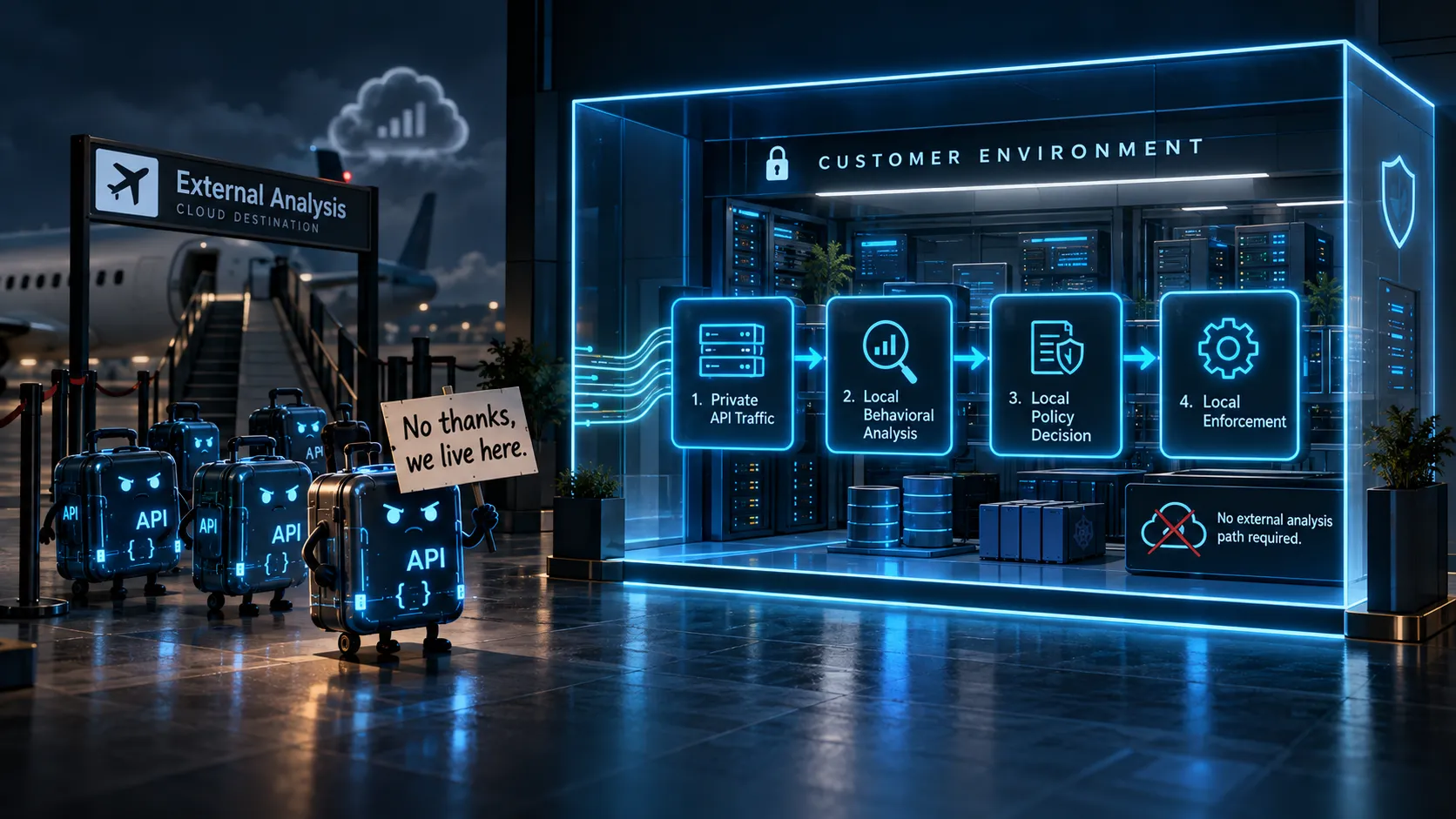
Proxyble Inside the Customer’s Environment
Proxyble runs inside the customer’s VPC, private network, or equivalent infrastructure boundary.
A simple deployment may look like this:
Client → Existing Ingress / API Gateway → Proxyble → Application
This is one possible topology, not a requirement. Proxyble can also run closer to individual services, including sidecar-style deployments, depending on the application’s network architecture.
The important point is where the decision process occurs.
As requests pass through Proxyble, it performs five core functions locally.
First, it observes traffic. Proxyble can measure signals such as source, endpoint, request frequency, response status, connection behavior, and other characteristics available in the request path.
Second, it measures behavior across requests. A burst of traffic, repeated failures, broad endpoint traversal, persistent retries, or sustained resource consumption often becomes meaningful only when viewed over time.
Third, Proxyble maintains the state required for that analysis inside the customer’s environment. It does not need to treat every request as an independent event.
Fourth, it evaluates configured policy against the observed behavior. Proxyble can determine whether traffic should continue normally or whether a configured control should apply.
Finally, it enforces the decision in the traffic path. Depending on policy, that may mean allowing traffic, limiting request rates, restricting connection behavior, reducing bandwidth, returning a temporary busy response, rejecting requests, or dropping clearly hostile traffic.
The full decision loop therefore remains close to the protected service:
Watch Traffic → Measure → Maintain state → Detect → Enforce
Proxyble does not need to send traffic to Proxyble-operated infrastructure in order to make these runtime decisions.
That has several practical consequences.
The customer controls the compute resources used for analysis. Behavioral context remains inside the environment. Enforcement does not depend on a remote decision round trip. Network latency to an external detection service is not part of the runtime decision path.
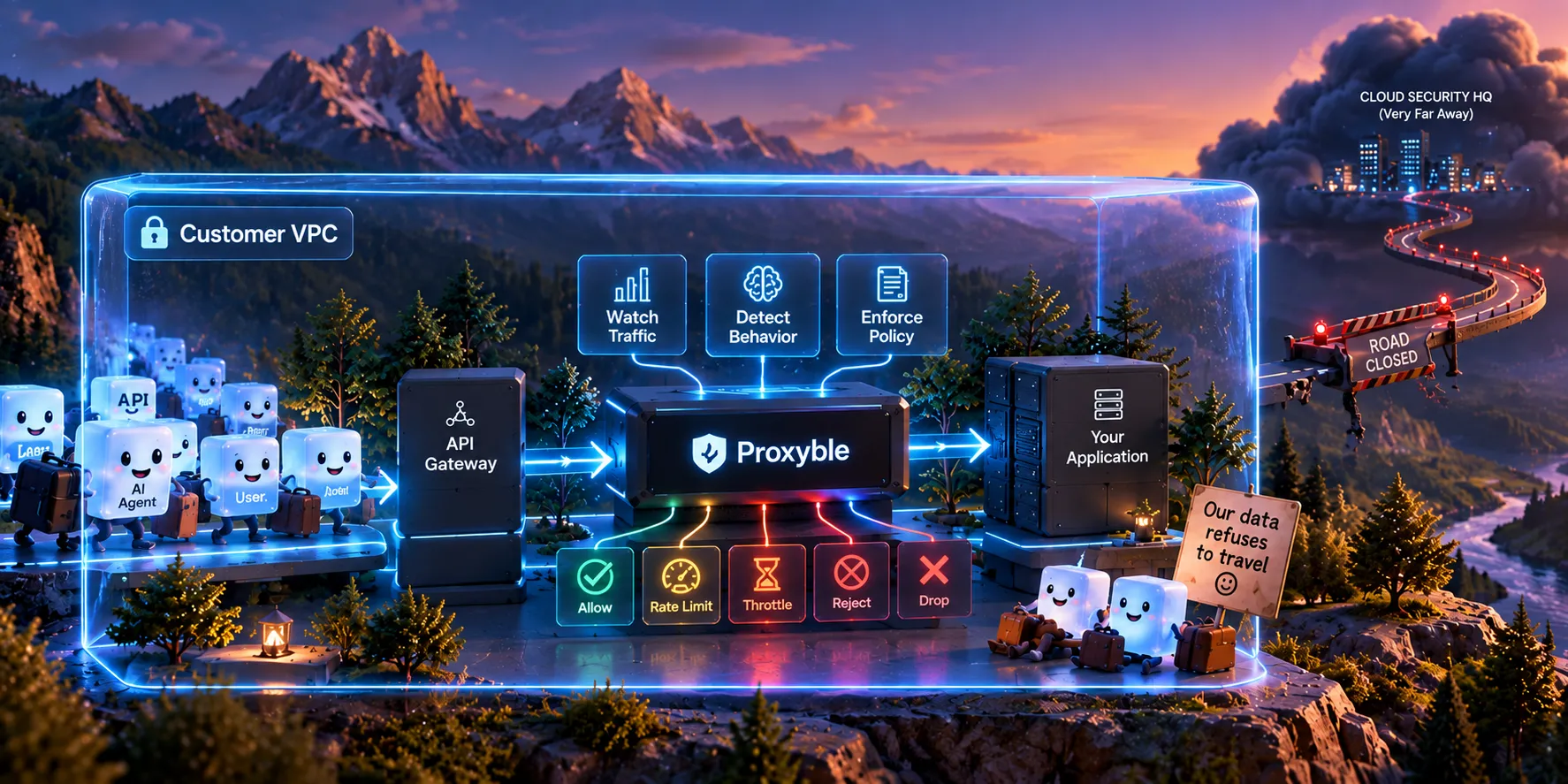
Fully Disconnected Operation
Requests remain inside the isolated network. Proxyble observes activity locally, maintains behavioral state locally, evaluates configured policies locally, and applies enforcement locally.
Its core runtime function does not require a remote service to evaluate each request or behavioral pattern. It also does not depend on a vendor-hosted control plane being reachable during runtime.
This matters for environments where external connectivity is intentionally absent or tightly prohibited. Examples may include isolated enterprise networks, sensitive internal systems, certain government or defense environments, industrial systems, and private services designed to operate independently of external networks.
In such environments, a security component that requires continuous communication with an Internet-hosted analysis system can conflict with the network architecture itself.
Scaling with Customer-Selected Hardware
Local deployment also changes who controls processing capacity.
Because Proxyble runs on infrastructure selected by the customer, the customer can size the deployment according to the workload instead of consuming a fixed external processing tier.
A small internal API may need only modest resources. A high-volume production system may require substantially more CPU, memory, or parallel capacity.
Proxyble’s architecture does not need to change simply because the workload grows.
Internal benchmark results illustrate the range:
| Instance | Measured processing rate |
|---|---|
AWS t4g.nano |
approximately 1,200 events/sec |
AWS c8g.2xlarge |
approximately 1,000,000 events/sec |
The benchmark examples demonstrate deployment range rather than a fixed performance promise.
Actual performance depends on several variables, including hardware, traffic characteristics, enabled policies, analytics workload, connection patterns, and deployment configuration.
A small service can run Proxyble on limited resources. A high-throughput environment can allocate substantially more compute. The customer can make that decision based on its own traffic and operating requirements.
The architectural takeaway is simpler: the customer controls the hardware budget and the processing capacity allocated to Proxyble.
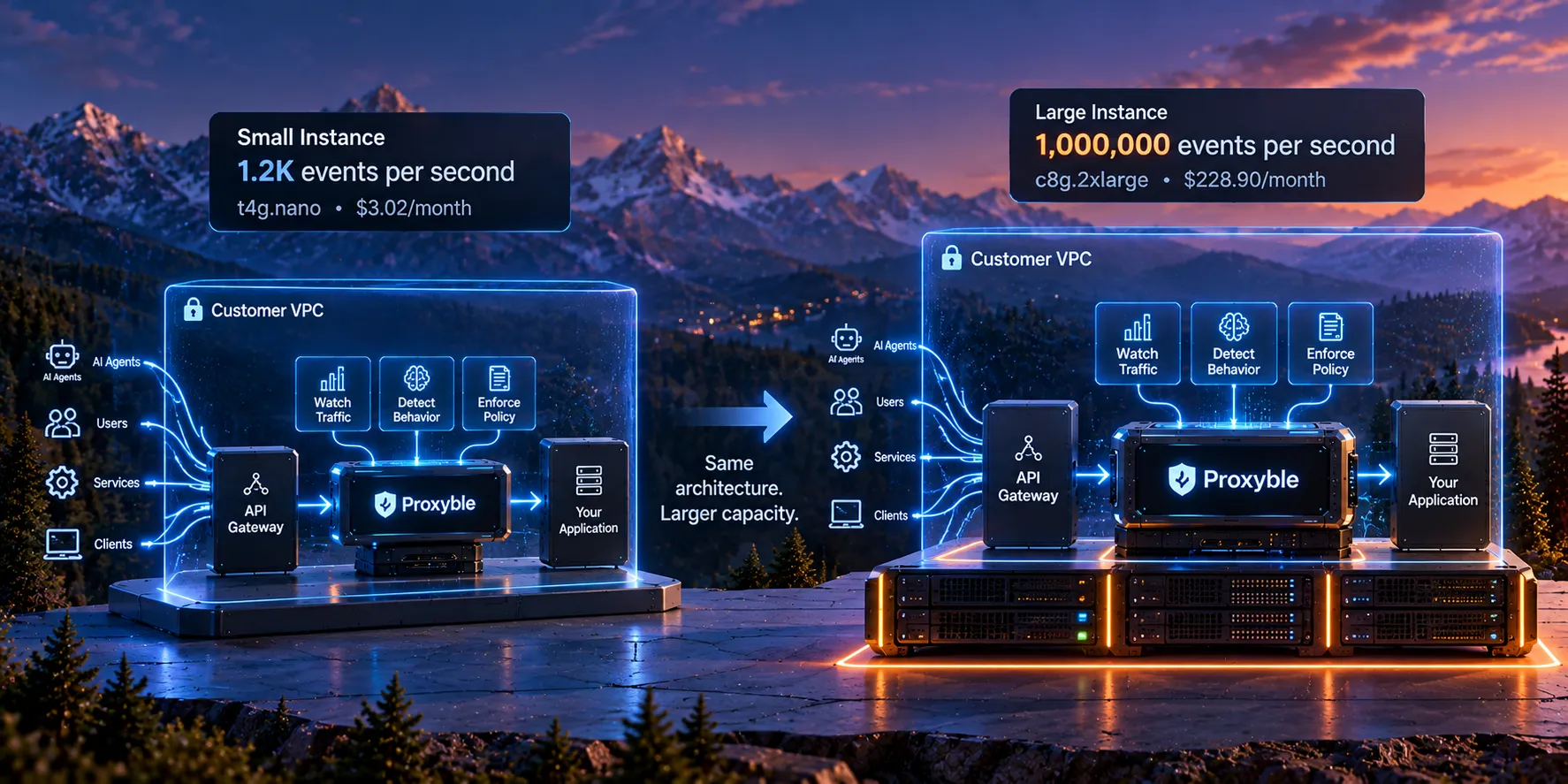
Please note that AWS pricing varies by region, purchasing model, operating system, and time.
Customer-Controlled Policy
Controlling the infrastructure is only one part of the deployment model.
Customers also control how Proxyble behaves.
Proxyble does not require every environment to use a single vendor-defined security policy. Its controls can be configured according to the protected application’s architecture, expected traffic patterns, operational requirements, and risk tolerance.
Different services often need different policies.
An authentication endpoint may need strict request-rate controls. A reporting API may need protection against repeated expensive operations or large exports. An internal service may need connection limits. An MCP server may need policies around tool-call rates or long-lived sessions.
Proxyble supports controls such as allow lists, block lists, endpoint-specific rate limits, connection-rate limits, concurrent-connection limits, bandwidth limits, busy deflection, retry-storm controls, expensive-endpoint controls, scraping controls, and MCP tool or session controls.
The response can also be graduated.
A customer may begin by observing behavior, collecting evidence, and generating alerts. As operators gain confidence in a policy, they may enable active responses such as rate limiting, temporary deflection, throttling, rejection, or dropping traffic considered clearly hostile.
There is no requirement to enable every available control.
The correct policy depends on what the service does, what normal behavior looks like, and what types of deviation the organization wants to constrain.
This becomes especially relevant in disconnected environments. If the runtime system must continue working without access to an external control plane, the required policy must also be available for local execution.
Proxyble therefore gives the customer control over both parts of the runtime model:
The customer chooses the infrastructure, and the customer chooses the policy that runs on that infrastructure.
Working with the Existing Stack
Local deployment does not require replacing the rest of the API infrastructure.
A typical production path might look like:
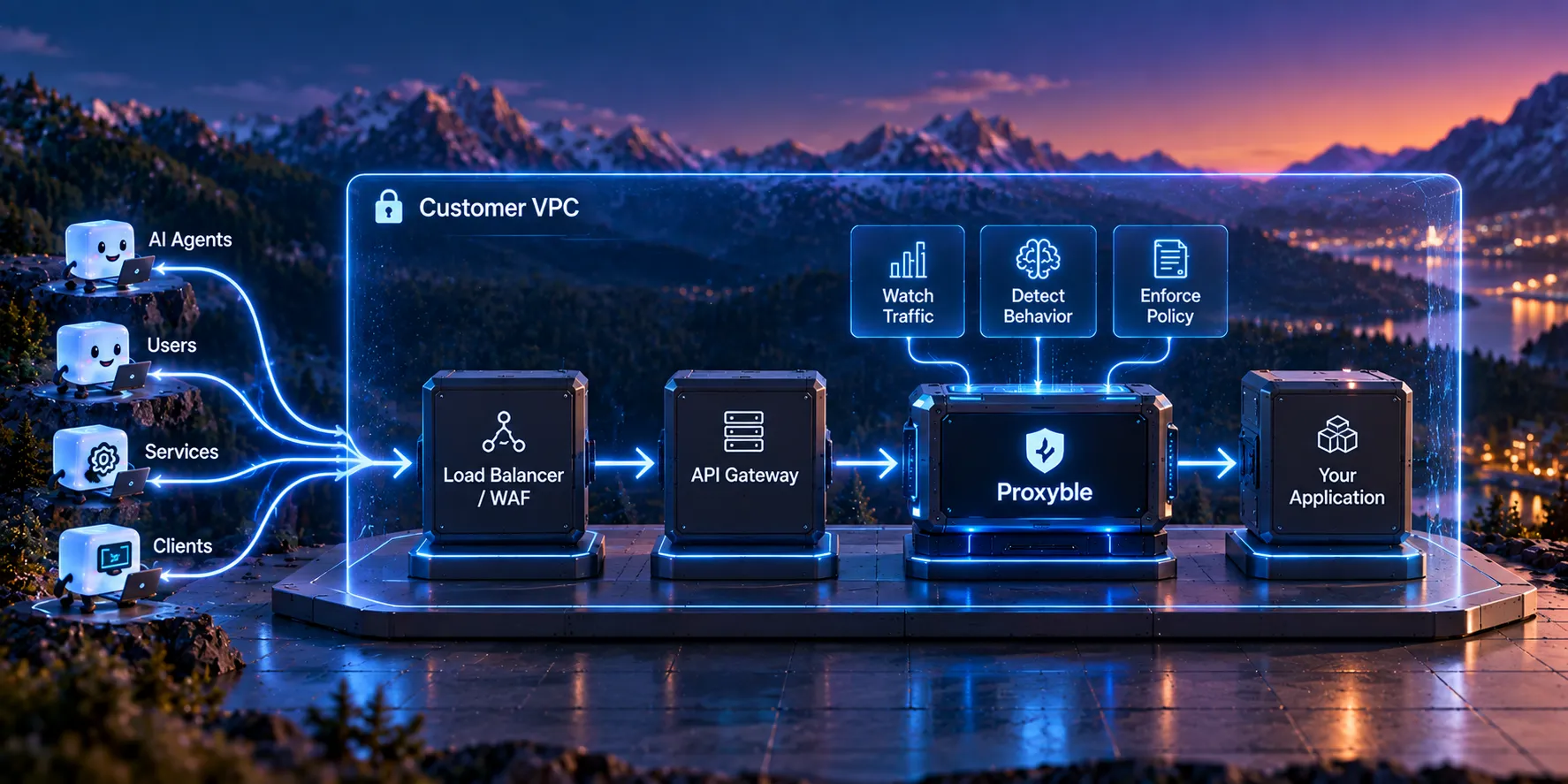
Alternative, side-car deployment could look like:
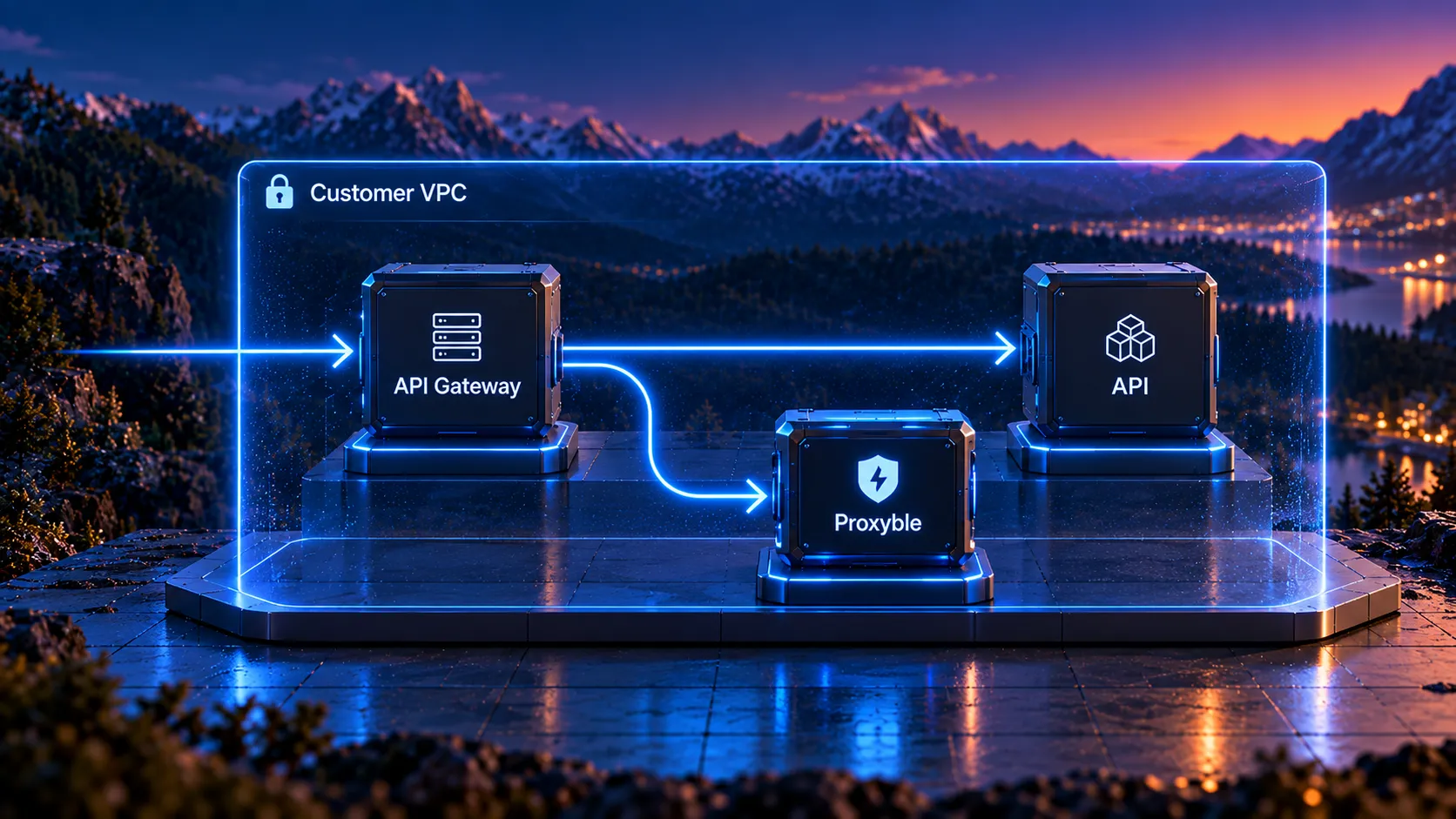
The exact placement depends on the environment.
Existing systems can continue performing their normal roles. IAM systems can handle identity, authentication, and authorization. WAFs can filter requests. API gateways can route traffic and apply gateway-level policies. SIEM systems can aggregate logs and security events.
Proxyble adds a separate capability: runtime behavioral analysis and enforcement in the live request path.
Its role is not to replace every surrounding control. It evaluates how a client behaves across requests and applies configured responses when that behavior becomes abusive, anomalous, operationally expensive, or inconsistent with policy.
That allows Proxyble to fit into an existing architecture without forcing the organization to redesign the entire security stack.
The same principle applies in both connected and disconnected environments.
In a private VPC, Proxyble can run locally while the rest of the environment continues using whichever external services the organization permits.
In a fully disconnected network, the same runtime analysis and enforcement can continue without an outbound Internet dependency.
Keep the Decision Next to the Traffic
The core architectural idea behind this deployment model is straightforward:
The security decision stays next to the traffic.
Traffic can remain inside the customer’s environment.
Runtime decisions can be made there.
Enforcement can happen there.
Organizations evaluating this architecture can deploy Proxyble inside an existing VPC, private network, or fully disconnected environment and test it using their own traffic patterns, policies, and hardware constraints.