Behavior After Access: Adding Runtime Behavioral Security to the API Stack
Proxyble adds continuous behavioral analysis and runtime enforcement to existing API infrastructure, helping teams evaluate not only whether a client is allowed to make a request, but whether its behavior remains safe over time.

The Existing Stack and the Missing Question
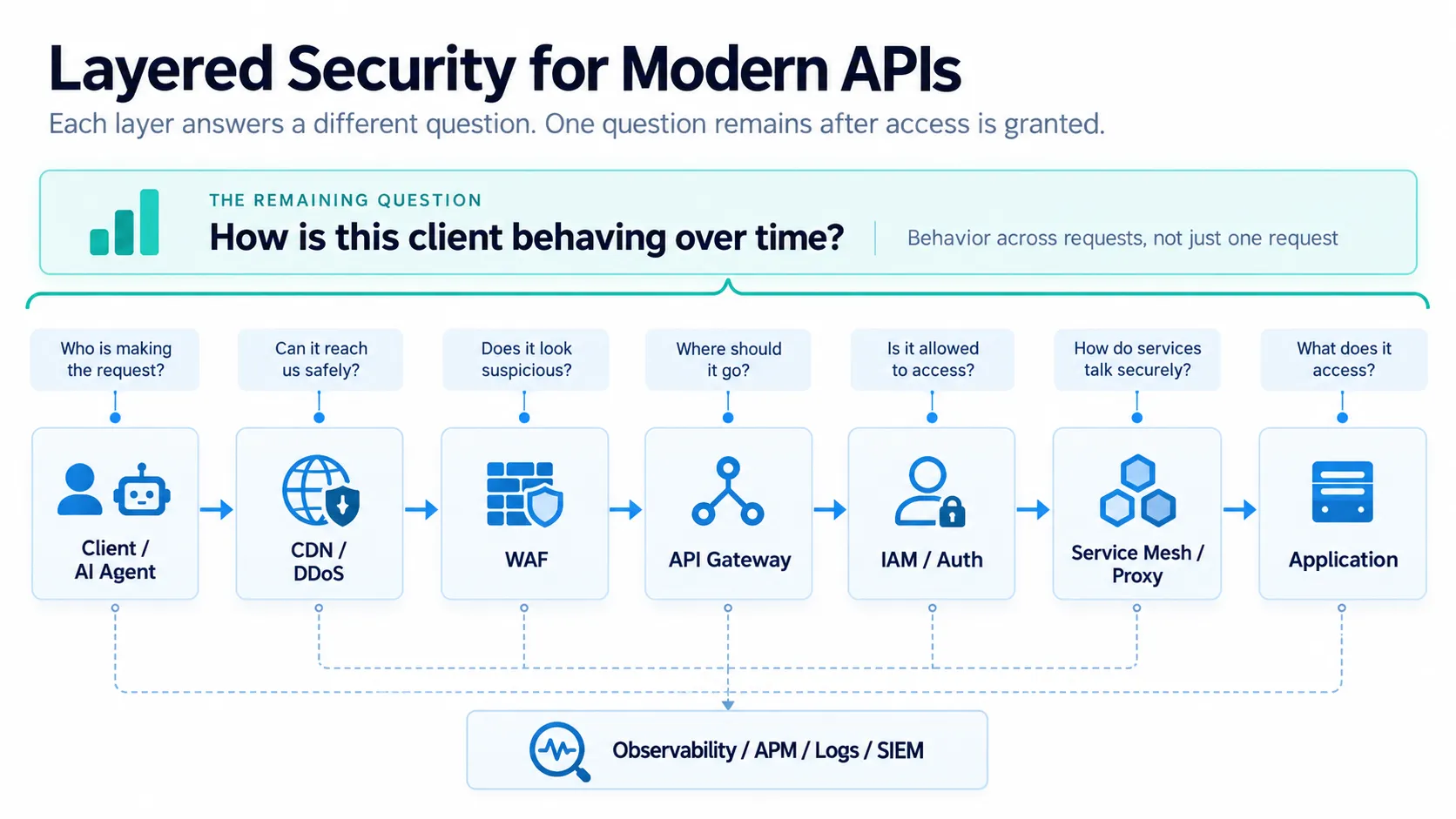
Modern services are rarely protected by a single security layer. A typical production architecture already includes several mature systems, each designed to solve a different part of the problem.
Traffic may first pass through a CDN or DDoS protection service, which absorbs large attacks and reduces load on origin infrastructure. A WAF can inspect requests for known attack patterns and other suspicious characteristics. An API gateway handles routing, authentication integration, quotas, and other API policies. IAM and OAuth systems establish identity and determine which operations a client may perform. Service meshes and proxies manage communication between services.
Alongside the request path, observability platforms, APM systems, logs, and SIEM tools help teams understand application health, investigate incidents, correlate events, and trigger operational or security workflows.
These systems answer important questions:
- Is this identity valid?
- Is this operation allowed?
- Does this request contain something suspicious?
- Is the service healthy?
But another question becomes important once access has already been granted:
What happens when a legitimate client begins behaving dangerously?
A valid credential can be stolen. A service account can be compromised. An automation job can enter a retry loop. A partner integration can suddenly generate far more traffic than expected. An AI agent can invoke an expensive API repeatedly. A client can consume large amounts of compute, bandwidth, or connection capacity while remaining below simple request-rate thresholds.
In each case, individual requests may still appear normal. They may be authenticated, authorized, syntactically valid, and harmless when examined in isolation.
The risk becomes visible in the sequence.
Ten requests to an export endpoint may be ordinary. Thousands over several hours may indicate data harvesting. A few retries after a failure are expected. Repeated retries across many connections can amplify an outage. A single expensive request may be legitimate. Persistent expensive requests from one client can create disproportionate infrastructure cost.
This is the distinction behind the phrase:
Authorized does not necessarily mean safe.
Authentication and authorization establish what a client is permitted to do. They do not, by themselves, determine whether the client’s behavior remains reasonable after access has been granted.
That remaining question is where Proxyble fits.
What Proxyble Is
Proxyble is an API security layer for the agentic era. It operates as a reverse proxy between clients and services, where it can observe traffic, maintain behavioral context, evaluate risk, and enforce policy while requests are being processed.
Many security and infrastructure decisions can be made from a request and its immediate context:
Request → inspect → decision
The decision may depend on identity, path, method, payload, headers, signatures, configured limits, or other available signals.
Proxyble adds a second level of analysis:
Requests over time → behavioral context → evaluate risk → select enforcement
The key difference is context across requests.
Proxyble asks not only:
“Can this client access this API?”
but also:
“Does the measured campaign of requests from this client appear to be a threat?”
A campaign of requests is simply the measurable sequence of requests associated with a client over time. The term does not imply malicious intent. It describes observable behavior: which endpoints the client calls, how frequently it calls them, how much data it transfers, what errors it produces, how many connections it creates, how long it remains active, and how those characteristics change.
Consider two clients governed by the same static limit of 100 requests per second.
Client A generates moderate traffic, calls a small and predictable set of endpoints, has normal idle periods, and produces few errors.
Client B also stays below 100 requests per second, but remains close to the threshold continuously, traverses many endpoints, repeatedly invokes expensive operations, generates large responses, and rarely becomes idle.
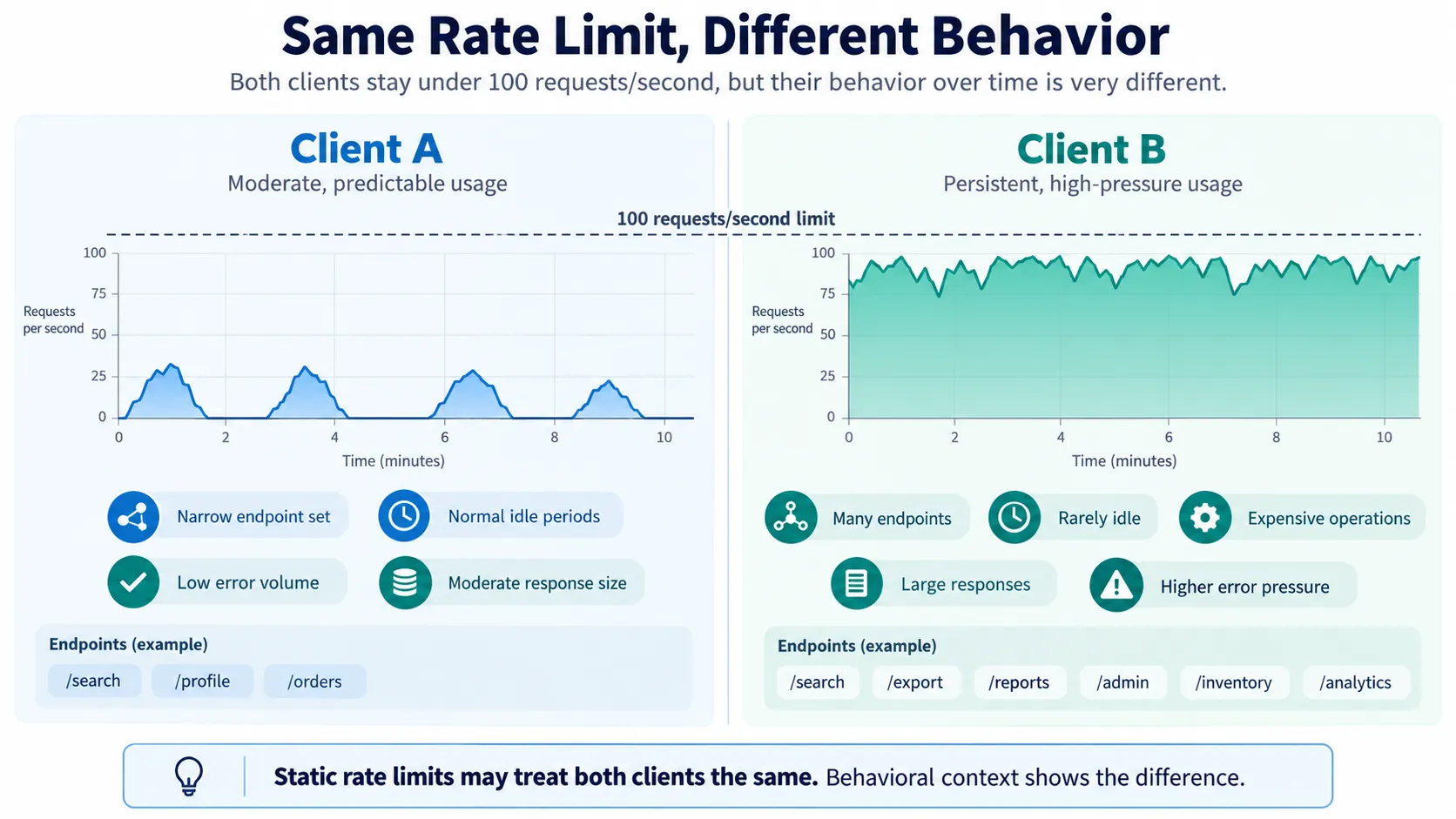
Both clients comply with the same rate limit. Their operational effect can be very different.
Proxyble analyzes patterns like these in real time. It can detect attacks, abuse, anomalies, inefficient automation, and policy violations; evaluate both authorized and unauthorized clients; apply enforcement; and retain evidence explaining why a decision or action occurred.
The next practical question is where that capability belongs in an architecture that already contains gateways, WAFs, proxies, and observability systems.
Where Proxyble Fits in an Existing Architecture
Proxyble is designed to complement infrastructure already handling API traffic. Because it operates as a reverse proxy, teams can place it at different points in the request path depending on which traffic and services need behavioral analysis and enforcement.
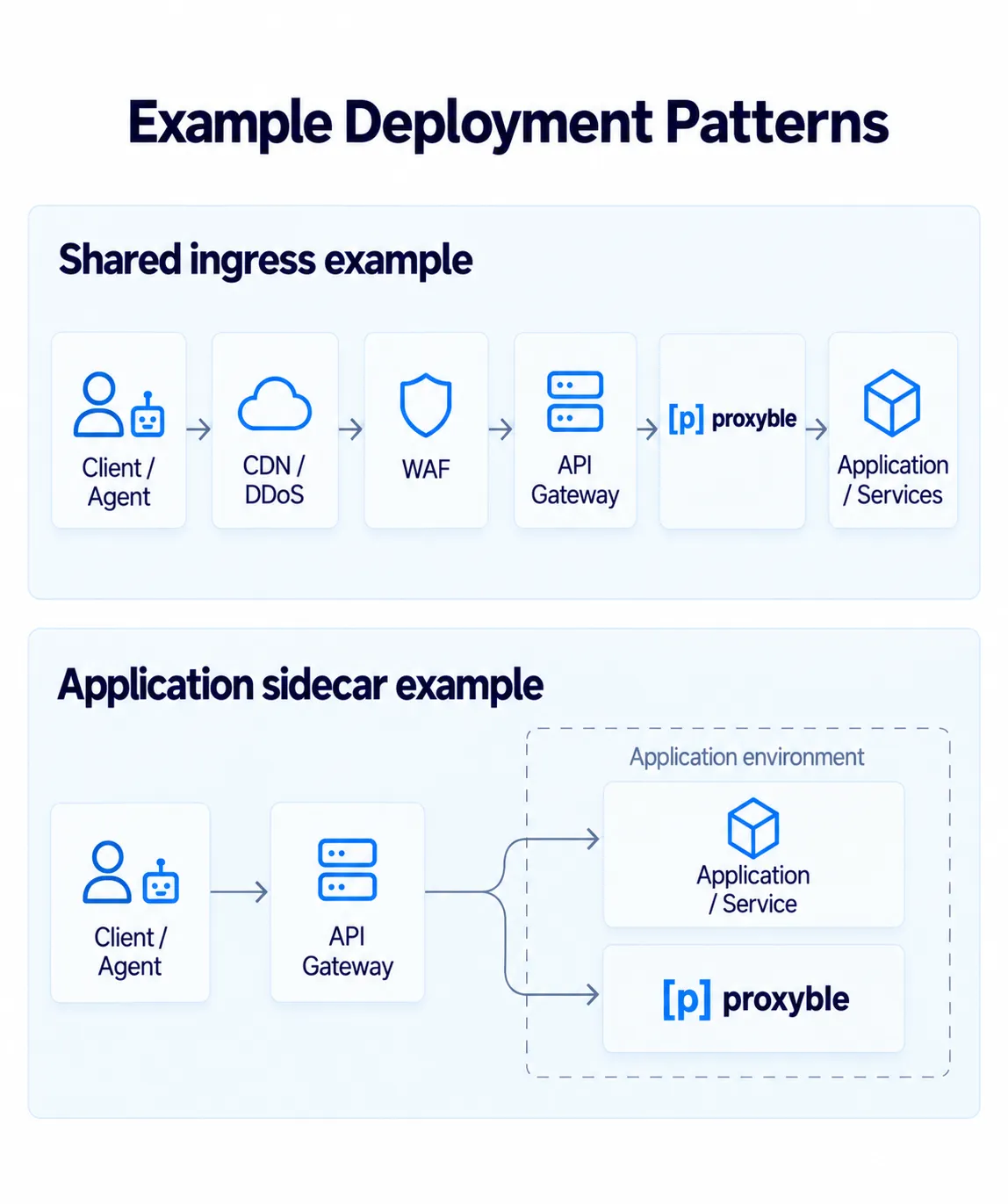
One option is an edge-oriented deployment:
Client / Agent
→ CDN / WAF
→ API Gateway
→ Proxyble
→ Application
In this arrangement, upstream edge systems continue to perform their normal functions, while Proxyble evaluates API-consumer behavior before traffic reaches the gateway and application. This can be useful when the same behavioral controls should cover a broad group of externally exposed APIs.
Another option places Proxyble as a side-car to the applicaton:
Client / Agent
→ CDN / WAF
→ API Gateway
   ├→ Application
   └→ Proxyble
Here, the existing gateway continues to handle routing, authentication integration, quotas, and other API-management concerns. Proxyble evaluates behavior for a particular application or service.
Because Proxyble works in the proxy layer, teams can add behavioral controls without implementing Proxyble-specific security logic throughout application code.
The exact location depends on the architecture. A team may want broad behavioral controls at shared ingress, more specific controls around sensitive services, or a combination of both.
| Technology | Primary role | What Proxyble adds |
|---|---|---|
| IAM / OAuth | Identity and authorization | Evaluation of behavior after access is granted |
| API Gateway | Routing, quotas, API management | Enforcement informed by observed consumption patterns |
| WAF | Request inspection and attack detection | Context accumulated across sequences of requests |
| CDN / DDoS protection | Edge delivery and large-scale attack protection | Per-consumer API behavior and resource-use analysis |
| Service Mesh | Service connectivity, identity, routing | Runtime controls for abusive or costly consumption patterns |
| Observability / APM | Visibility into service and application health | Inline action against traffic contributing to a condition |
| SIEM | Security-event aggregation and investigation | Runtime decisions, enforcement, and supporting evidence |
| Proxyble | Behavioral analysis and runtime enforcement | Continuous evaluation of API-consumer behavior over time |
These categories are not rigid boundaries. Modern gateways, WAFs, meshes, observability platforms, and security products increasingly overlap. Some already provide behavioral detection, automated remediation, or adaptive controls.
The distinction is therefore about primary responsibility and architectural focus, not an absolute feature boundary. Proxyble is specifically built around maintaining behavioral context for API consumers and using that context in runtime enforcement decisions.
The value of this additional context becomes clearer in situations where each request looks acceptable but the pattern formed by many requests does not.
Concrete Behavioral Security Examples
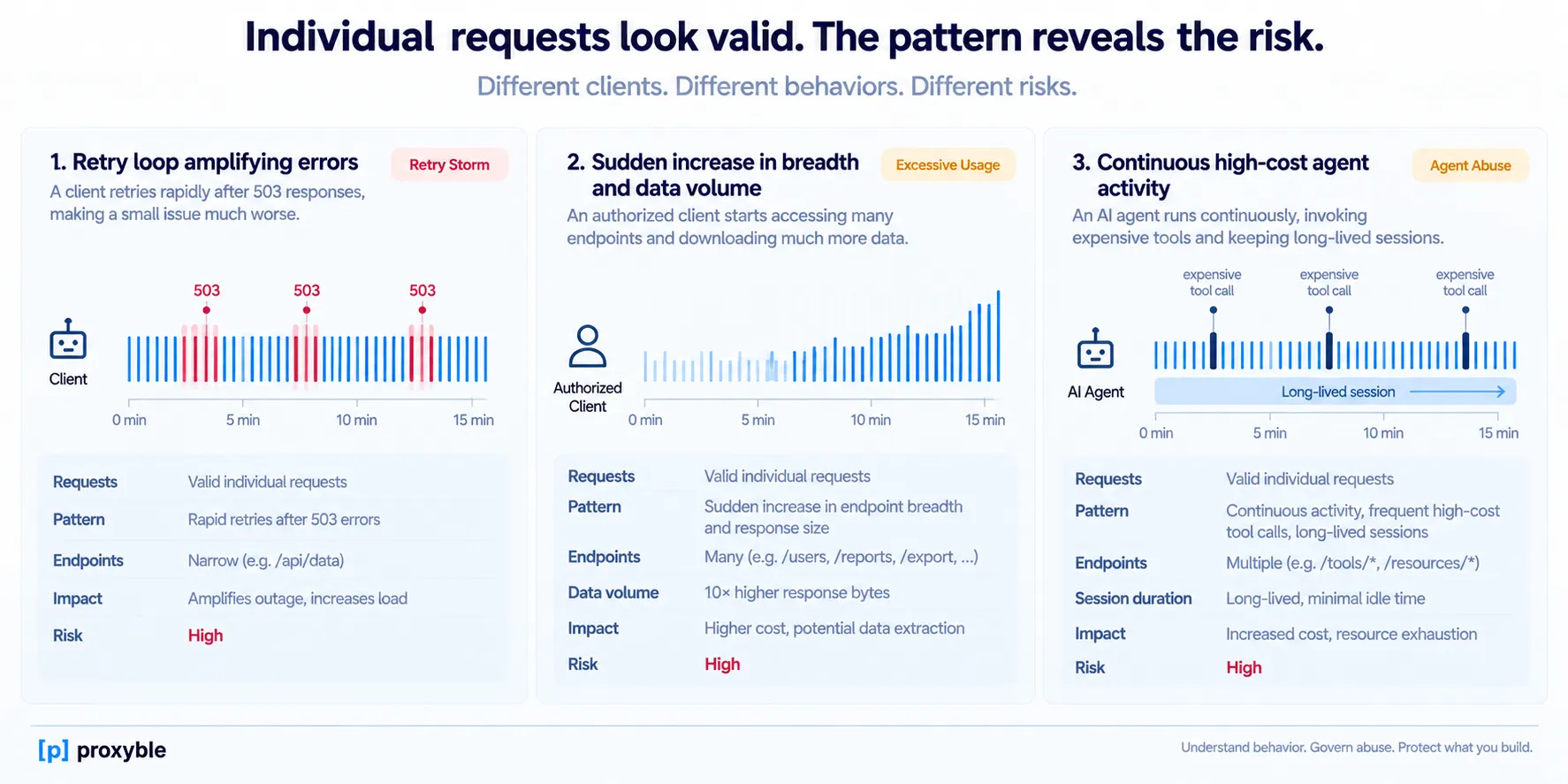
Retry Storm
A backend begins returning HTTP 503 responses. An automated client interprets the failures as temporary and retries immediately.
The sequence can become self-reinforcing:
Backend returns 503 → client retries rapidly → load increases → more requests fail → client retries again
The client may be fully authenticated and authorized. Each retry may be a valid request to a permitted endpoint. There may be no malicious payload or exploit signature.
Existing infrastructure can already help through retry policies, circuit breakers, load shedding, gateway limits, or client-side backoff. Behavioral analysis adds another signal: the relationship between rising 5xx responses, short retry intervals, repeated calls, connection churn, and increasing pressure on an unhealthy service.
Proxyble can identify that pattern and apply temporary pressure relief. Depending on policy, it could reduce the client’s request rate, limit new connections, slow traffic, or return a busy response that encourages the client to back off.
Compromised Authorized Client
Consider an integration using a valid API key, OAuth token, or service account. Authentication continues to succeed, and the credential still permits the requested operations.
But its behavior changes.
The client begins touching many more endpoints than usual. It performs repeated exports, downloads substantially more data, operates continuously instead of periodically, and generates error patterns not normally associated with that integration.
None of these signals alone proves credential theft. A legitimate application change or new workload might explain the traffic.
Together, however, they provide evidence that the client’s current behavior differs materially from its previous or expected consumption pattern.
Existing controls still matter. IAM defines what the credential may access. Gateways enforce configured policies and quotas. WAFs inspect traffic. Monitoring systems expose resulting activity. Proxyble adds the ability to evaluate the evolving sequence itself and use that behavior as an input to runtime policy.
A response might begin with evidence collection and tighter limits, then escalate to temporary restrictions or quarantine if the behavior persists and confidence increases.
AI Agents and Machine-Speed Consumption
An AI agent does not need to be compromised or malicious to create operational problems.
An authorized agent can repeatedly invoke the same tool, recursively trigger downstream calls, retry failures too aggressively, consume expensive endpoints, hold many MCP sessions open, or generate large responses continuously.
The challenge is not simply speed. Software consumers can operate without the natural pauses and practical limits associated with human interaction.
An agent may stay below a configured per-second request limit while continuously consuming an expensive endpoint for hours. Another may create many long-lived sessions without producing useful work. A third may react to transient failures by launching retries across several tools.
The useful signals can include persistence, endpoint cost, response size, session occupancy, retry behavior, route spread, error pressure, connection churn, and idle time.
Proxyble policies such as Retry Storm Control, Expensive Endpoint Cost Control, MCP Tool Pressure Control, MCP Session Occupancy Control, and Large Download and Export Control represent different ways to turn those observations into enforceable operating rules.
The response does not have to begin with a block. Traffic can first be slowed, constrained, or shaped according to the risk it creates.
That raises the next question: once risky behavior is detected, what should the system do about it?
From Detection to Graduated Enforcement
Not every problematic client is malicious, and not every anomaly deserves a ban.
A trusted partner may temporarily generate excessive load. A broken client may enter a retry loop. An AI agent may consume more resources than its designers intended. A scanner that repeatedly probes endpoints and ignores limits may justify a stronger response.
The appropriate action depends on risk, persistence, resource impact, and confidence.
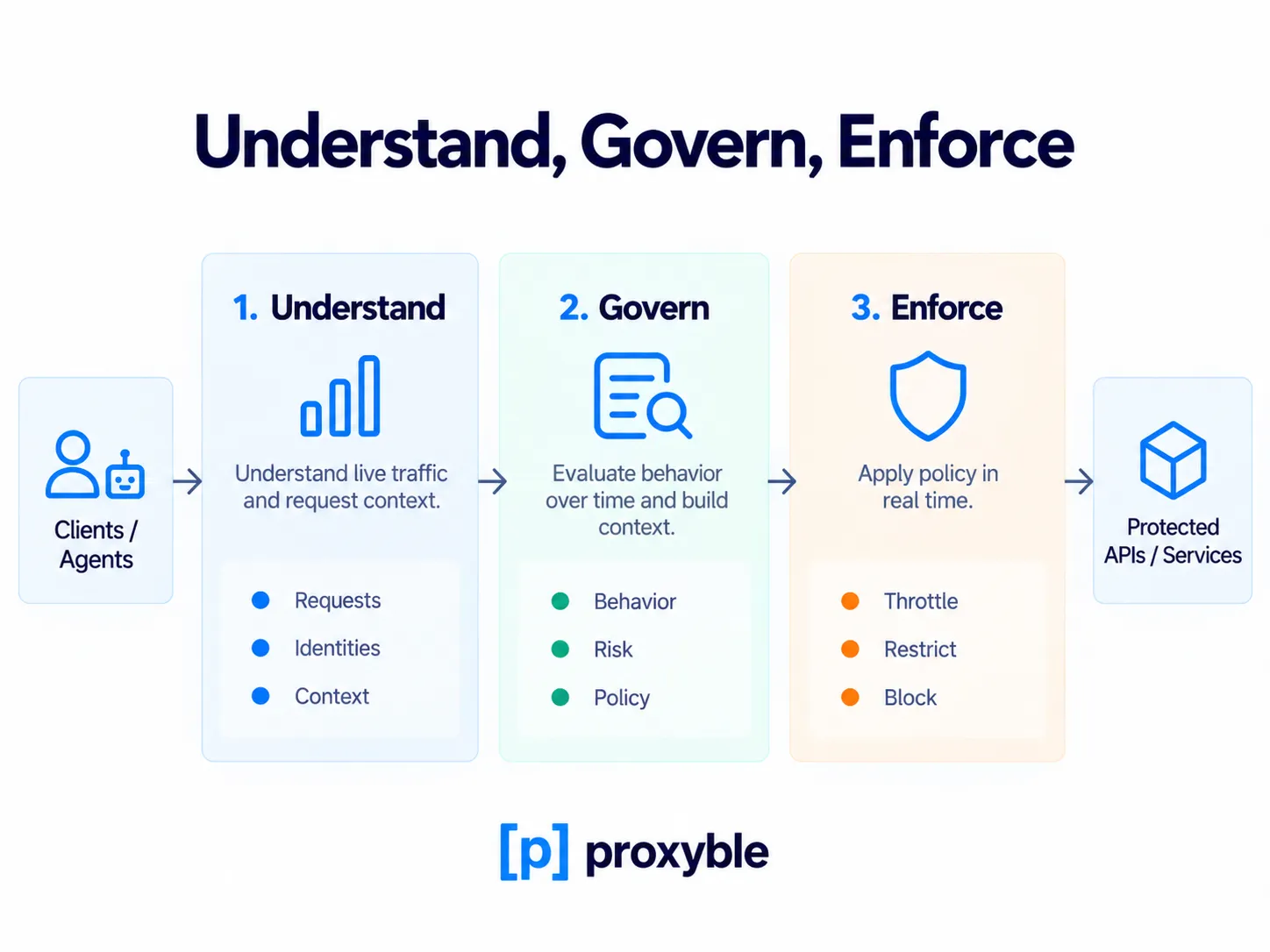
A useful model is:
Understand → Govern → Enforce
At the understand stage, Proxyble observes live traffic and request context. It tracks requests, identities, endpoints, errors, resource use, and other signals needed to build a reliable picture of API activity.
At the govern stage, Proxyble evaluates behavior over time. It combines current activity with accumulated context to assess risk and determine which policy should apply as a client’s behavior changes.
At the enforce stage, Proxyble applies that policy in real time. Depending on the situation, it can throttle traffic, restrict specific behavior or resources, reject requests, or block clearly hostile activity.
Consider an authorized integration that begins retrying an expensive endpoint after repeated failures. Proxyble might first collect evidence while the pattern develops. If pressure increases, policy could reduce the endpoint rate and limit new connections. If the behavior continues while backend stress grows, stricter temporary restrictions could follow. A hard rejection becomes an option only when the configured policy and observed behavior justify it.
This approach is particularly useful for authorized clients. Immediately blocking a legitimate integration can create its own outage. Graduated enforcement provides a way to reduce harmful behavior while preserving as much legitimate activity as possible.
It also places behavioral enforcement in the broader context of defense in depth.
Defense in Depth
Modern API security works best as a set of complementary layers.
Authenticate identity. Establish who or what is making the request.
Authorize operations. Determine which resources and actions that identity may access.
Inspect requests. Evaluate requests for attacks, malformed input, suspicious characteristics, and policy violations.
Observe infrastructure. Monitor service health, latency, errors, resource use, traffic, and security events.
Understand behavior. Evaluate how a client uses the API across requests and over time.
Enforce policy as behavior changes. Adjust the response when consumption becomes risky, abusive, inefficient, or operationally harmful.
Proxyble is primarily concerned with the final two layers. It adds behavioral context and runtime enforcement to infrastructure that may already include IAM, API gateways, WAFs, CDNs, service meshes, observability platforms, and SIEM systems.
That distinction matters as the population of API consumers changes.
APIs are used by applications, partner integrations, internal services, automation, bots, AI agents, and MCP clients and tools. These software consumers can operate continuously, make decisions autonomously, and generate interactions at a scale and cadence that differ from human-driven use.
The important change is therefore not merely more traffic. It is that granted access may be exercised continuously and autonomously, while the operational risk of that activity can change from one moment to the next.
Authentication and authorization remain essential. But API security cannot stop when access is granted.
Organizations also need to evaluate how that access is being used while the interaction is occurring, and apply proportionate controls when behavior changes.
Learn how Proxyble can be added to an existing API stack.