API Security for AI Agents: Why Authentication Isn't Enough
Authentication and authorization establish identity and permissions, but runtime behavioral security is needed to govern how AI agents use APIs and MCP capabilities over time.

Authentication Solves Identity, Not Behavior
Authentication answers a necessary question: Who is this client?
An API might authenticate a client using an API key, OAuth token, signed request, certificate, workload identity, or another credential. Once validation succeeds, the service can associate incoming traffic with a user, application, partner integration, internal service, or AI agent.
Authorization answers the next question: What is this client allowed to do?
A policy might permit the authenticated identity to query /search, retrieve a customer record, generate a report, invoke a particular MCP tool, or open a session with an MCP server.
These controls remain foundational. They establish identity and permission. What they do not necessarily establish is whether the client will exercise those permissions safely over time.
An individual request can pass authentication, authorization, schema validation, and application checks while the campaign of requests becomes operationally harmful.
Scenario Repeated calls to an expensive analysis endpoint
Consider an AI agent that is legitimately authorized to invoke an expensive analysis endpoint. A single call may be entirely appropriate. Ten calls may also be appropriate. But if the agent invokes the operation hundreds of times in rapid succession, the accumulated effect can change: database load rises, model inference consumes additional capacity, downstream dependencies become saturated, latency increases, or infrastructure cost grows.
Every request may still be valid.
Scenario Retries multiply across the agent and SDK
The same distinction appears in retry behavior. Suppose an authorized client receives a 429 or transient 503 response. A conventional application might wait according to a retry policy. An AI agent may also interpret the failure as a reason to try again, perhaps through a different sequence of actions. If an SDK adds its own retries and several agent tasks are executing concurrently, repeated recovery attempts can multiply.
The credentials are still valid. The requested action may still be permitted. Yet the resulting runtime behavior can increase pressure precisely when the service is already struggling.
Scenario An authorized agent traverses many endpoints
Breadth matters too. An agent may traverse many legitimate endpoints or tools while gathering information or planning a task. Each operation can be allowed independently. The overall pattern may nevertheless create unexpected load, resemble discovery, or touch capabilities far beyond the usual workflow.
None of these cases automatically implies malicious intent.
The agent may simply be following instructions too literally. A planning loop may cause repeated work. A software defect may duplicate tasks. An SDK may retry aggressively. An adversarial instruction contained in external content may influence an otherwise authorized agent to perform inappropriate actions. Credentials may also be compromised, but compromise is only one possible explanation.
This creates an important distinction between malicious access and dangerous behavior by an authorized consumer.
A useful runtime security question is therefore not only whether a client is permitted to perform an action, but how that client is behaving across many actions.
Proxyble focuses on that post-authorization problem. It is an API security layer for the agentic era that analyzes API traffic and behavioral patterns in real time, maintains context across requests, and can evaluate both unauthorized activity and the behavior of authorized consumers.
Its core question is:
Does the measured campaign of requests from this client appear to be a threat?
The wording matters. The question concerns measured behavior, not a claim to know the client’s intent.
This distinction becomes more important as APIs are consumed by autonomous or semi-autonomous software rather than only by people operating conventional applications. Agents do not merely increase traffic. They change its behavioral shape.
AI Agents Change the Shape of API Risk
Human-driven applications usually contain natural pacing. A person reads a page, reviews a result, enters data, and decides what to do next. Software agents can compress many of those steps into seconds.
An agent can issue requests continuously, execute tasks in parallel, follow pagination automatically, retry failures, traverse capabilities, and consume large outputs without the pauses that human interaction normally introduces.
The result is not simply higher requests per second.
Runtime pressure can emerge from combinations of:
- request rate;
- endpoint or tool distribution;
- concurrency;
- retries;
- connection creation;
- response volume;
- request duration;
- backend latency;
- compute cost;
- session occupancy.
Request rate remains useful. It simply does not describe the entire workload.

Persistence, action order, endpoint breadth, and resource cost change the impact of otherwise valid requests. The following scenarios show how those dimensions differ.
Scenario Layered retries amplify a partial outage
Humans often notice when a workflow has stopped making useful progress. Agents may continue executing.
A failed operation can be retried repeatedly. Pagination can continue through thousands of results. An agent may attempt several alternative actions after one path fails. It may continue after partial success because its plan still contains unresolved steps.
Each action may be reasonable in isolation. Persistence changes the aggregate effect.
Suppose a service begins returning intermittent 503 responses. A client library retries automatically. The agent also decides that the operation should be attempted again. Several tasks are running concurrently. Each mechanism may be sensible on its own, but together they can amplify load during a partial outage.
That is a common mechanism behind a retry storm.
A retry storm does not require an attacker. A broken client, duplicated recovery logic, an aggressive SDK, or a reasonable retry policy applied at the wrong scale can create similar pressure.
Scenario Dynamic planning changes the request sequence
An agent often chooses its next action based on the result of the previous one.
A search result may lead to a detail lookup. That response may trigger another query. A failed tool call may cause the agent to select a different capability. An incomplete result may lead it to broaden the search.
The resulting traffic is a sequence, not merely a collection of unrelated requests.
Order can therefore matter.
Ten calls to ten endpoints may be routine if they form a known workflow. The same endpoints visited in another sequence may indicate an inefficient planning loop, unusual exploration, or unintended traversal.
The individual calls can look identical while the relationship among them changes the interpretation.
Scenario An agent expands beyond its usual endpoint set
A single agent task may legitimately touch many endpoints, services, tools, or resources.
That breadth should not automatically be classified as reconnaissance. Research, deployment, support, and orchestration tasks may require broad capability access.
But fan-out still provides behavioral context.
An agent that normally uses three operations but suddenly moves through dozens of uncommon paths at machine speed deserves a different evaluation from one following a familiar task sequence. Whether the spread is acceptable depends on the workload, surrounding signals, and policy.
Scenario A few expensive calls outweigh many cheap ones
Some operations create much more backend work than others.
A client generating 100 requests per second may be harmless if those requests are cheap, cached, and expected. Another generating five requests per second may be far more expensive if every request starts a complex database query, invokes a model, generates a report, or returns hundreds of megabytes.
A complex search may trigger multiple joins or downstream calls. A report request may start substantial computation. An export may generate gigabytes of output. A model-inference request may consume far more compute than hundreds of lightweight metadata operations.
This creates an asymmetry between the number of requests and the resources they consume.
Low-volume traffic can therefore create high pressure. High-volume traffic can remain harmless when the requests are cheap and expected.
This is why behavioral evaluation may consider latency, bytes, endpoint choice, errors, retries, concurrency, connection behavior, or resource cost where those measurements are available.
Not every deployment needs every signal.
Scenario Automation stays below the limit for hours
The difficult cases are often neither clearly malicious nor clearly benign.
An authorized automation may submit legitimate business actions too quickly, generate too many exports, repeatedly execute an expensive workflow, or operate continuously near a configured limit with almost no idle time.
A static limit may still serve as a useful hard boundary. Behavioral context can reveal what happens inside that boundary.
Two clients may both remain below the same rate limit. One produces short bursts followed by long idle periods. The other stays just below the threshold continuously for hours. Their instantaneous rates are similar; their cumulative pressure is not.
These patterns show why safe operating bounds need context beyond permission and a static counter. As organizations give autonomous software access to more structured capabilities, the same questions arise in MCP environments.
MCP Makes Post-Authorization Behavior Explicit
MCP gives agents structured access to capabilities exposed by an MCP server. Depending on the deployment, those capabilities may include tools, resources, sessions, or streaming interactions.
For security purposes, the important point is not the protocol mechanics. It is that MCP provides a clear environment in which an authenticated and authorized agent can repeatedly exercise shared capabilities.
Permission to use a tool does not define how frequently it should be invoked.
Permission to access a resource does not define how broadly it should be traversed.
Permission to create a session does not necessarily define how many concurrent sessions should be occupied or how aggressively a client should reconnect.
These are operational questions that appear after access has been granted.

MCP pressure can come from repeated tool use, occupied sessions, recovery loops, or large outputs. Each consumes a different part of the service’s capacity.
Scenario Valid MCP tool calls create cumulative pressure
Consider an MCP tool that performs search across a large dataset.
An authorized agent may invoke it repeatedly while refining a query. That can be completely legitimate. But if the agent enters a planning loop and performs hundreds of nearly identical searches, the impact changes even though every invocation remains allowed.
A more expensive tool makes the asymmetry clearer.
An analytics tool may perform substantial database work. A generation tool may invoke a model. A document-processing tool may consume CPU, memory, or a third-party API quota. A retrieval tool may produce large responses.
A relatively small number of calls can create disproportionate downstream cost.
An agent may also traverse a large part of the exposed tool set while deciding how to accomplish a task. That may be normal exploration. It may also reflect inefficient planning or unintended capability traversal.
Scenario Concurrent MCP sessions exhaust shared capacity
Some MCP deployments involve persistent sessions, streaming interactions, or connections that remain active while work is performed.
Long-lived sessions are not inherently abusive. They may be exactly what an application requires.
The concern is excessive or unexpected occupancy relative to policy and operating conditions.
A client might open many simultaneous sessions. Sessions may remain active much longer than expected. A reconnect bug may create new connections repeatedly. Several agent tasks may independently establish streaming interactions until a limited pool of connections, workers, or backend resources becomes constrained.
An individual connection can be valid while aggregate occupancy becomes harmful.
Proxyble’s Occupancy Control addresses patterns such as long-lived or excessive MCP streaming sessions, reconnect churn, and pressure on scarce session capacity.
Again, the relevant distinction is between permission and consumption. Permission to establish a session does not imply unlimited use of all resources supporting that session.
Scenario MCP retries and reconnects compound a failure
MCP workloads can experience the same feedback loops as other distributed systems.
Suppose an MCP server begins responding slowly or intermittently fails. The SDK retries. The agent sees an incomplete result and invokes the tool again. A supervisory workflow restarts the task. The transport reconnects.
Each component may be attempting recovery.
Together they may create more requests, more connections, and more work in flight while the service has less capacity available.
The observable problem is amplification, regardless of whether it originated from an attacker or broken automation.
Scenario Modest call rates produce oversized outputs
An operation that returns a few hundred bytes and finishes in milliseconds has a different resource profile from one that produces a large dataset, generates extensive content, executes a costly query, or starts an expensive workflow.
An authorized agent may repeatedly request large resources or invoke high-output operations. Request frequency may remain modest while bandwidth, latency, compute consumption, or downstream expense becomes significant.
This is another reason tool-call count alone may not describe MCP pressure.
Scenario A legitimate research goal exceeds operating bounds
Suppose an agent receives a legitimate objective:
“Find all relevant records and analyze them.”
That describes the desired result. It does not define acceptable use of shared infrastructure.
The agent may determine that the fastest approach is to run hundreds of searches in parallel, keep several sessions open, retrieve large resources repeatedly, or retry an expensive tool until it succeeds.
Those actions may be consistent with the agent’s objective while exceeding the service’s operating bounds.
Scenario A permitted tool sequence repeats at scale
MCP also illustrates why sequences matter.
An agent might invoke one tool to retrieve identifiers, another to fetch details, a third to perform analysis, and a fourth to export the result.
Each tool call may be permitted and individually harmless.
If the sequence repeats continuously, fans out across thousands of resources, or repeatedly returns to an expensive operation after partial failures, the resource impact becomes visible only across the sequence.
This is a campaign-level problem.
The agent’s prompt, plan, or current objective is not a substitute for infrastructure policy. A platform may allow the task while still constraining the frequency, concurrency, bandwidth, session occupancy, or resource cost used to complete it.
From Individual Requests to Behavioral Campaigns
A useful behavioral security system therefore needs context accumulated over time.
The signal can emerge only after the system observes how the request relates to previous and subsequent actions from the same client.
That accumulated view is behavioral context.
The purpose of behavioral context is not to collect every possible measurement. It is to preserve enough history to evaluate the behavior that matters for the protected workload.

Behavioral context connects cost, persistence, traversal, and recovery behavior. The comparisons below revisit those dimensions to show what becomes visible across a campaign.
Scenario Same request count, different cost
Suppose two agents each make 1,000 requests.
The first retrieves small cached resources. The responses complete quickly and create little backend work.
The second repeatedly invokes report generation and complex search operations. Those calls trigger expensive queries, long execution times, and large responses.
The request count is identical. The resource effect is not.
Endpoint choice, latency, response size, or known resource cost can provide context that raw count misses.
Scenario Same rate, different persistence
Now consider two clients operating below a configured rate limit.
One produces short bursts followed by long idle periods.
The other runs continuously just below the threshold for several hours.
Neither violates the static rule. But their cumulative effects differ.
This does not make the rate limit obsolete. It illustrates a different decision layer. A fixed limit defines a boundary; behavioral context describes how a client behaves within that boundary.
Scenario Same authorization, different traversal pattern
Two authorized clients may have permission to access the same set of endpoints or MCP tools.
One follows a familiar workflow: retrieve an object, inspect details, modify a related record, and finish.
The other rapidly spreads across dozens of uncommon paths.
Broad traversal may be legitimate. Some tasks genuinely require it.
But when unusual spread appears together with high speed, repeated failures, connection churn, or other signals, the resulting campaign deserves a different evaluation from the expected workflow.
No single endpoint needs to be prohibited.
Scenario Failures become more meaningful with retries
An increase in failures is not automatically a security event. Services fail, dependencies degrade, and clients make mistakes.
The surrounding response matters.
A rise in 429 or 5xx responses becomes more concerning when the same client reacts with rapid retries, increasing concurrency, or repeated connection creation.
Those combinations can indicate a retry storm or broken recovery loop.
The security system can recognize that the pattern is hazardous without claiming to know why the client produced it.
Scenario MCP tool sequences reveal cumulative pressure
The same approach applies to MCP.
An agent might search, retrieve resources, call an analytics tool, and generate a large result. Every call is allowed.
If the sequence repeats continuously, spreads across many resources, or repeatedly re-enters an expensive tool, accumulated tool pressure becomes visible only across multiple events.
This accumulated context is why Proxyble frames the decision around the campaign of requests:
Does the measured campaign of requests from this client appear to be a threat?
“Appears” is important.
Behavioral evidence is not proof of intent. An anomaly is not automatically an attack. A risk assessment is not proof of credential compromise. A problematic campaign may originate from a malicious actor, a compromised account, a software defect, a runaway agent, or legitimate behavior under unusual operating conditions.
Detection and enforcement should therefore remain separate concepts.
First, the system observes and evaluates behavior. Then policy decides what, if anything, should happen.
That raises an architectural question: where should this behavioral state be maintained, and where can enforcement occur while the behavior is still in progress?
Where Runtime Behavioral Enforcement Fits
Proxyble addresses that question as a reverse proxy with built-in real-time analytics, typically deployed alongside the protected service using a sidecar model.
In this arrangement, the existing ingress path continues delivering production traffic to the API or MCP server, while the same traffic is made available to Proxyble for behavioral analysis.
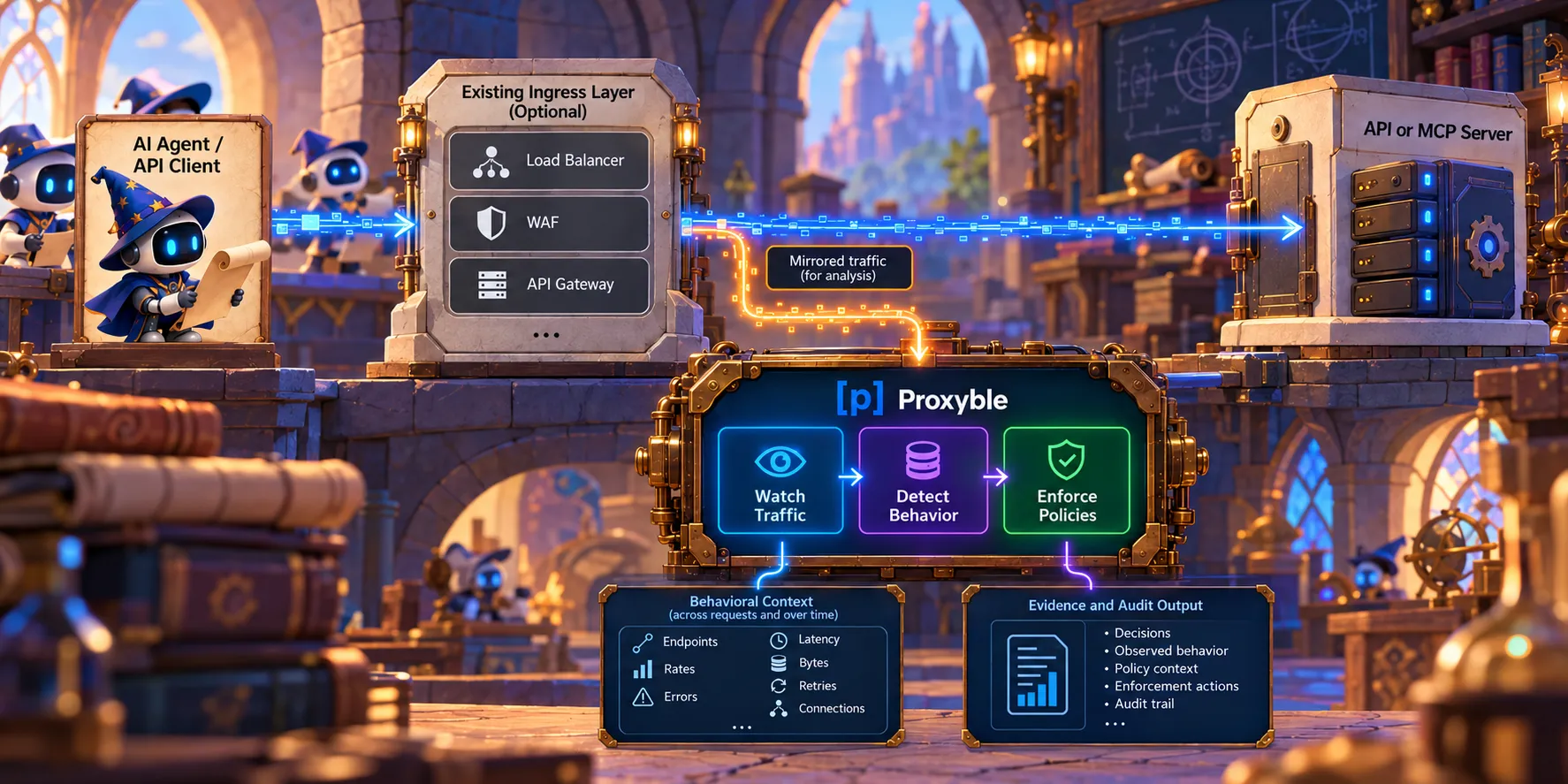
Proxyble therefore operates alongside the protected service rather than adding another application-level hop to the primary request path. The exact integration can vary by architecture, but the sidecar model allows behavioral monitoring and policy enforcement without requiring changes to application code.
Observation occurs on live traffic
Proxyble analyzes API traffic and behavioral patterns in real time.
The observation stage can collect measurements relevant to the configured policies: endpoints or tools used, request and response rates, status codes, retries, latency, transferred bytes, connection behavior, and other available signals.
If the policy requires action, enforcement can occur while the traffic path remains active.
Traffic-path placement enables immediate action
When the component evaluating behavior is positioned in or adjacent to the live traffic path, it can act on the traffic that is currently applying pressure rather than only recording the event for later analysis.
That is particularly useful for conditions such as retry storms, endpoint pressure, session occupancy, or connection churn, where the operational effect is still unfolding.
Evidence from the decision can also be retained or forwarded for operator review.
Existing controls remain complementary
Proxyble joins an existing security and traffic stack, so each component can continue answering the questions it was designed to answer. IAM establishes identity and permission. An API gateway manages access, routing, and API-level controls. A WAF applies configured protections to web-facing traffic. Observability platforms and SIEMs collect, correlate, and operationalize telemetry.
Those responsibilities can overlap. A gateway may implement sophisticated rate controls, a WAF may maintain state, and an observability platform may trigger remediation. The distinction is the role Proxyble adds to the path: it maintains behavioral context specific to the protected application and its customers, then evaluates that context against per-customer runtime policies while the traffic is still active.
This makes Proxyble complementary to the surrounding controls. It can use the identity and routing decisions already established upstream, then add a continuing view of how an authorized client uses the API across requests. Evidence from those decisions can flow to existing observability or SIEM systems, while enforcement can happen close enough to the protected service to relieve pressure as it develops.
The placement also keeps this behavioral logic outside application code. The protected API can continue serving its business functions while Proxyble observes the relevant traffic and applies the configured policy around it.
Enforcement Should Match Risk, Not Just Permission
Behavioral enforcement does not need to reduce every situation to allow or block.
Using the same response for different clients would discard information about risk, confidence, and operational conditions.
Proxyble therefore supports graduated responses that can range from observation to stronger intervention.

The response should match the resource under pressure and the strength of the evidence. The scenarios below explain how observation, temporary pressure relief, and targeted controls can preserve useful access.
Scenario An unusual workflow needs observation first
Some patterns deserve observation before they deserve restriction.
A new endpoint sequence may be unusual but benign. A temporary increase in traffic may reflect an expected job. A new MCP workflow may legitimately traverse tools that have rarely been used together.
In these cases, the appropriate action may simply be alerting and evidence collection.
Behavioral security is more useful when policy can distinguish “interesting” from “must be stopped.”
Scenario A legitimate burst needs temporary pressure relief
Suppose a normally well-behaved client suddenly produces a sharp burst of valid traffic.
The cause might be synchronization, batch work, queued user demand, or an agent completing several tasks in parallel.
If the surrounding behavior remains clean but the service is approaching pressure, a long ban may be disproportionate.
Proxyble’s BUSY DEFLECTION can return a temporary busy response so the client backs off. LIMIT RATE SLOW can apply rate-limit responses to reduce request frequency without excluding the source entirely.
These controls can preserve access while reducing pressure.
Static limits remain useful here. Behavioral evidence can help determine whether the situation warrants a temporary adjustment or something stronger.
Scenario A retry storm needs controls on amplification
Consider a client that receives repeated 429, 503, or other failure responses and immediately creates more requests or connections.
If connection creation is contributing to the problem, LIMIT CONNECTION RATE can constrain how quickly the source creates new connections.
Temporary busy responses or rate controls may also be appropriate, depending on the failure mode.
The purpose is to reduce amplification.
The system does not need to decide that the client is malicious in order to recognize that the current recovery behavior is making the situation worse.
Scenario An expensive endpoint needs targeted controls
Aggregate traffic volume may look normal while one operation creates most of the resource cost.
Suppose an agent calls inexpensive metadata endpoints frequently but also invokes a report-generation path several times per minute.
The total request rate may be moderate. The report workload may still saturate workers, database capacity, or downstream services.
LIMIT ENDPOINT RATE can constrain that specific path rather than reducing unrelated API activity.
For workloads where long-running backend work is part of the problem, TIMEOUT can shorten how long requests from the source are allowed to remain active.
For repeated large downloads or output-heavy operations, LIMIT BANDWIDTH can reduce response pressure while preserving access.
The enforcement target should follow the resource being exhausted.
Scenario MCP tool pressure and session occupancy need different controls
The same distinction applies to MCP.
An agent may repeatedly invoke one expensive tool while other interactions remain ordinary. The appropriate response may be to throttle the relevant behavior rather than disconnect the agent from the MCP environment entirely.
If the pressure instead comes from too many simultaneous connections or sessions, LIMIT CONCURRENT CONNECTION addresses a different problem.
Tool pressure, session occupancy, bandwidth consumption, and reconnect churn are distinct operating conditions. Their controls need not be identical.
Trust Must Continue After Login
The resulting security model is additive rather than substitutive.
- Authenticate the actor.
- Authorize the capability.
- Observe how that capability is used.
- Evaluate behavior over time.
- Enforce policy when behavior becomes risky.

As autonomous software becomes another class of API consumer, access control remains the foundation. Runtime governance adds the continuing decision: whether authorized capabilities are still being exercised within safe operating bounds.